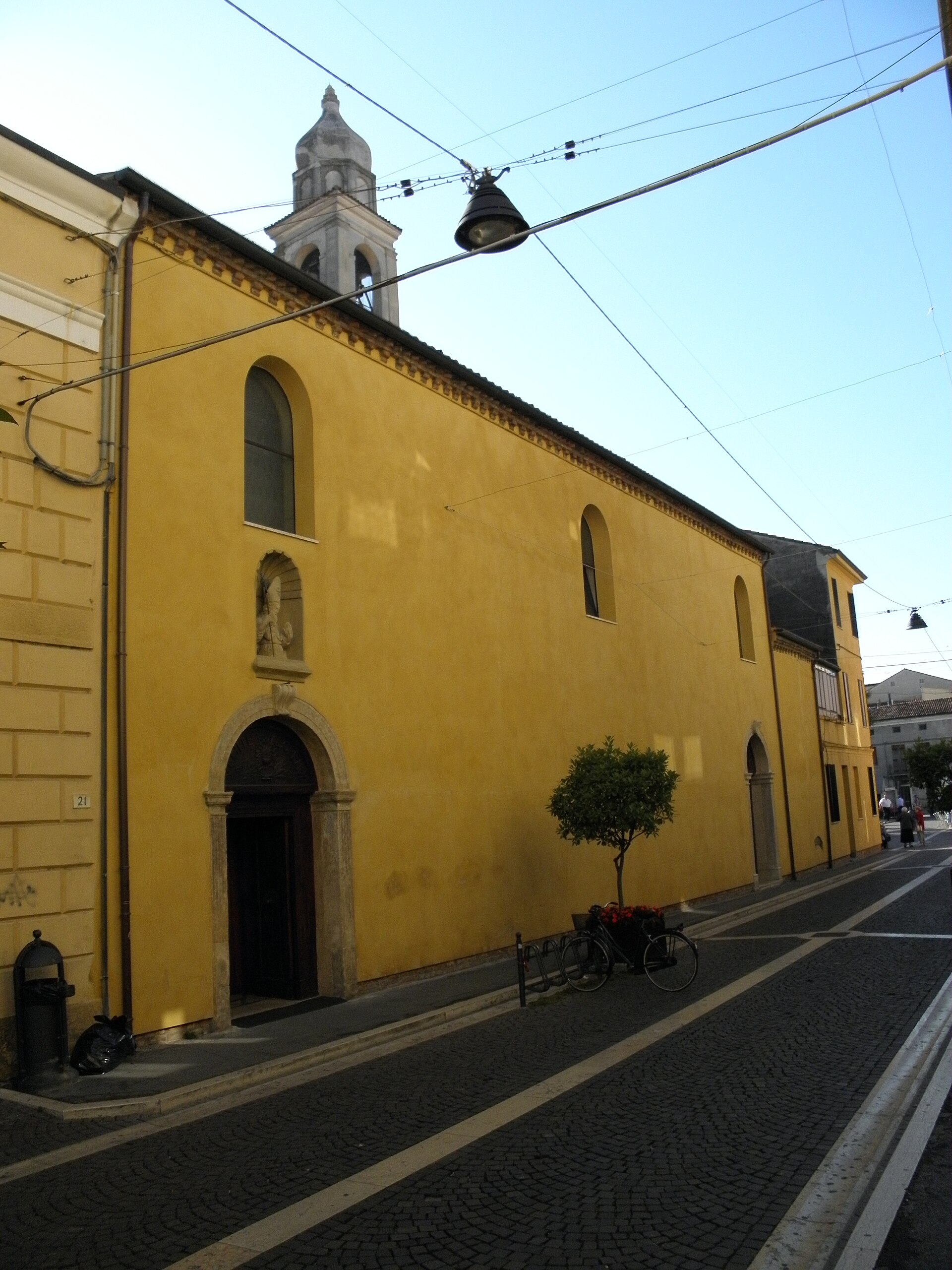
Walk along Via X Luglio, between Piazza Garibaldi and Piazza Annonaria, and you could easily pass it without noticing. It has no churchyard. It has no real façade. It shows the city only its flank, like someone who would rather not be seen. And yet behind that wall lies one of the most layered places in the heart of Rovigo.
A will and a hospital
Its official name is Sant’Antonio Abate, and at first the Dominican friars had nothing to do with it. In the early 1500s the Casalini brothers had a will to honour: they were to rebuild the hospital of Sant’Antonio, founded in 1413 and later destroyed by fire. The church rose beside the hospital. According to the local historian Montacciani, it was built between 1505 and 1516, with just two altars: one for Saint Anthony, the other for Saints Lucy, Sebastian and Roch.
That is why it seems to hide. It was never meant to face a square. It began as a hospital chapel, hemmed in by other buildings. Its small mystery has a historical answer.
A gift to the Preachers
The Casalini, however, did not run the place well. Documents of the time record that certain women found shelter in the church, and that prostitutes were living in the rebuilt section. So the family decided to hand everything over to the Friars Preachers, the Dominicans. It was a practical choice: to entrust church and hospital to an order able to look after them.
On 29 April 1542 the Dominican Provincial Chapter, meeting in Venice, accepted the gift. In June 1543 the friars took possession of the complex. On 23 September of that same year the church was consecrated.
Altar by altar
Under the Dominicans the complex grew. In 1551 a chapel was added to the right of the high altar, granted to Bonaventura Casalini. In the same years the altar of the Madonna del Rosario took shape, a devotion to Our Lady of the Rosary typical of the Order. In 1563 it was adorned with an altarpiece on canvas commissioned by Pietro Paolo de’ Paoli.
In 1627 the Order approved the enlargement of church and convent, paid for by Andrea Redetti, and the number of friars rose to eight. In 1633 the convent became an independent priory. Between 1641 and 1644 a chapel was added to mirror the Casalini one, with a stone altar for Saint Anthony. The older chapel held a wooden altar of San Liberale. Finally, in 1687, came the altar of San Domenico. In less than a century and a half the little hospital chapel had become a conventual church, rich in altars and devotions.
From convent to market square
The Dominican chapter closed in the 18th century. In 1767 the Venetian Republic (the Serenissima) suppressed the convent, judging it too small, and in 1770 the friars left the city. In 1810 Napoleon’s laws against the religious orders followed.
After Napoleon’s fall, it was a bishop who reopened the doors. In September 1815 Bishop Molin secured the church’s return to worship. In under fifty years it had lost its friars, closed its doors and then opened them again. The convent met a different fate. According to the sources, it became a barracks of the Guardia di Finanza (Italy’s finance police) until 1857. It was then demolished to build the covered market, which later passed to the municipality. Where the friars once prayed and lived, Piazza Annonaria, the old market square, now opens out.
The traces that remain
The church has been restored several times: the roof in 1887, the frescoes of the choir and side chapels in 1889. In 1906 two large windows were opened in the eastern wall. A recent restoration uncovered a great doorway on an inner wall of Piazza Annonaria. It is the last thread still binding the church to its vanished convent.
Today San Domenico is open for worship, and some online listings describe it as a place of perpetual Eucharistic adoration. To step inside is to cross five centuries in a few paces: from the Casalini hospital to the friars of the Rosary, and on to the city of the market.