The Po Delta landscape we see today is largely the result of a political decision. It was taken in Venice more than four hundred years ago.
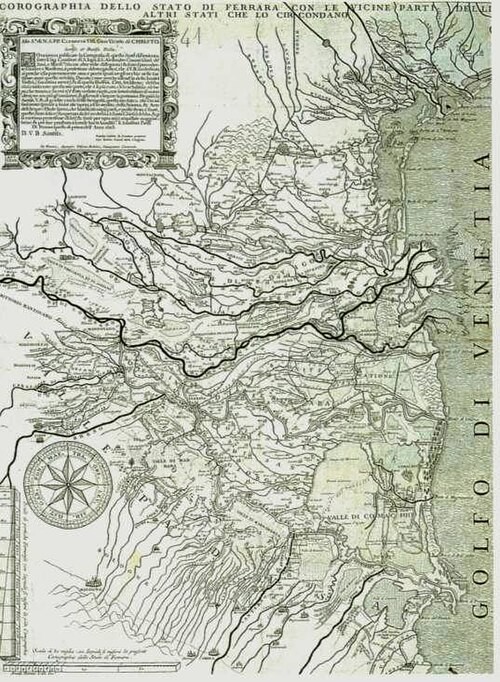
In the 16th century the Venetian Republic (the Serenissima) watched the Po di Tramontana, the river’s northern branch, with growing alarm. Its sediment threatened to silt up the lagoon towards Chioggia and choke trade. There were fears, too, that the Adige might join that branch and make matters worse. The debate between engineers and magistrates went on for more than half a century.
The right moment
The turning point came from politics. In 1598 Ferrara passed from the Este family to the Papal States, and 1600 was a Jubilee year: Pope Clement VIII could not afford a war.
On 27 August 1599 the Senate approved Alvise Zorzi’s plan. It called for an artificial canal about seven kilometres long, across land in today’s municipalities of Taglio di Po and Porto Viro, which would divert the waters of the Po south-east, towards the Sacca di Goro.
Seven kilometres of toil
Work began in 1600, under Doge Marino Grimani. It was not easy: sabotage and strikes slowed it down more than once.
On 16 September 1604 the provveditore (the Venetian official in charge), Zuan Giacomo Zane, informed the Senate that the water had entered the canal. The work cost about 300,000 gold ducats, twice the estimate.
New land from the sea
The consequences were enormous. The faster-flowing Po began to build new land out towards the sea. The modern delta advanced into the Adriatic far more quickly than before. On that newborn land, Venetian patricians founded estates and residences.
In papal territory the opposite happened. The Sacca di Goro and the old southern branches silted up, and vast areas turned to marsh.
Today, watching the Po di Venezia flow quietly by, it is hard to imagine the toil and tensions of those years. And yet the landscape all around still bears the mark of that cut.