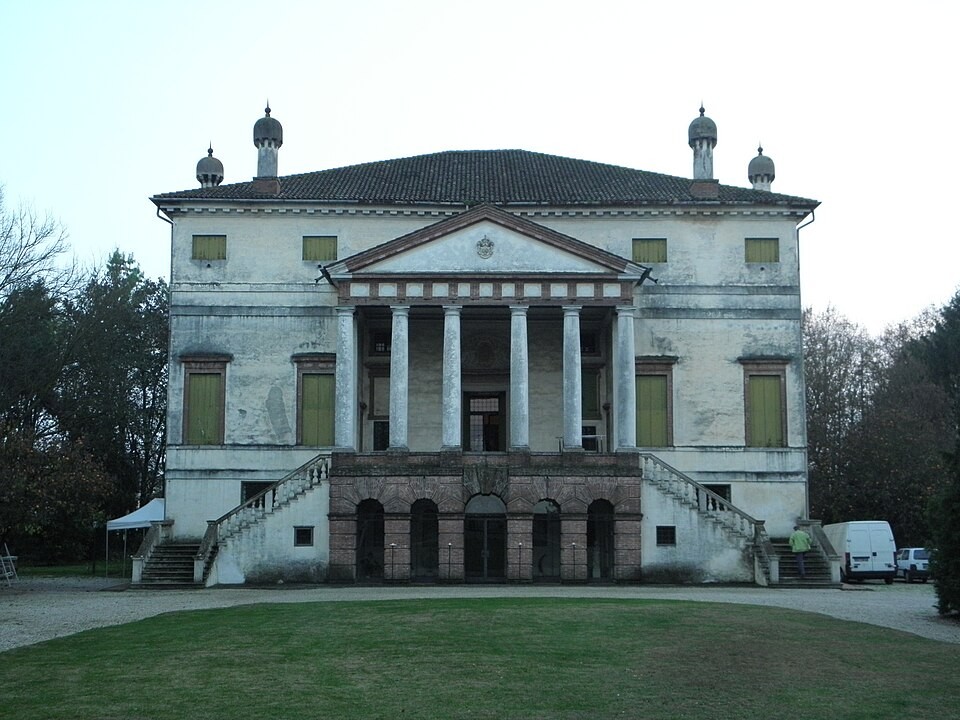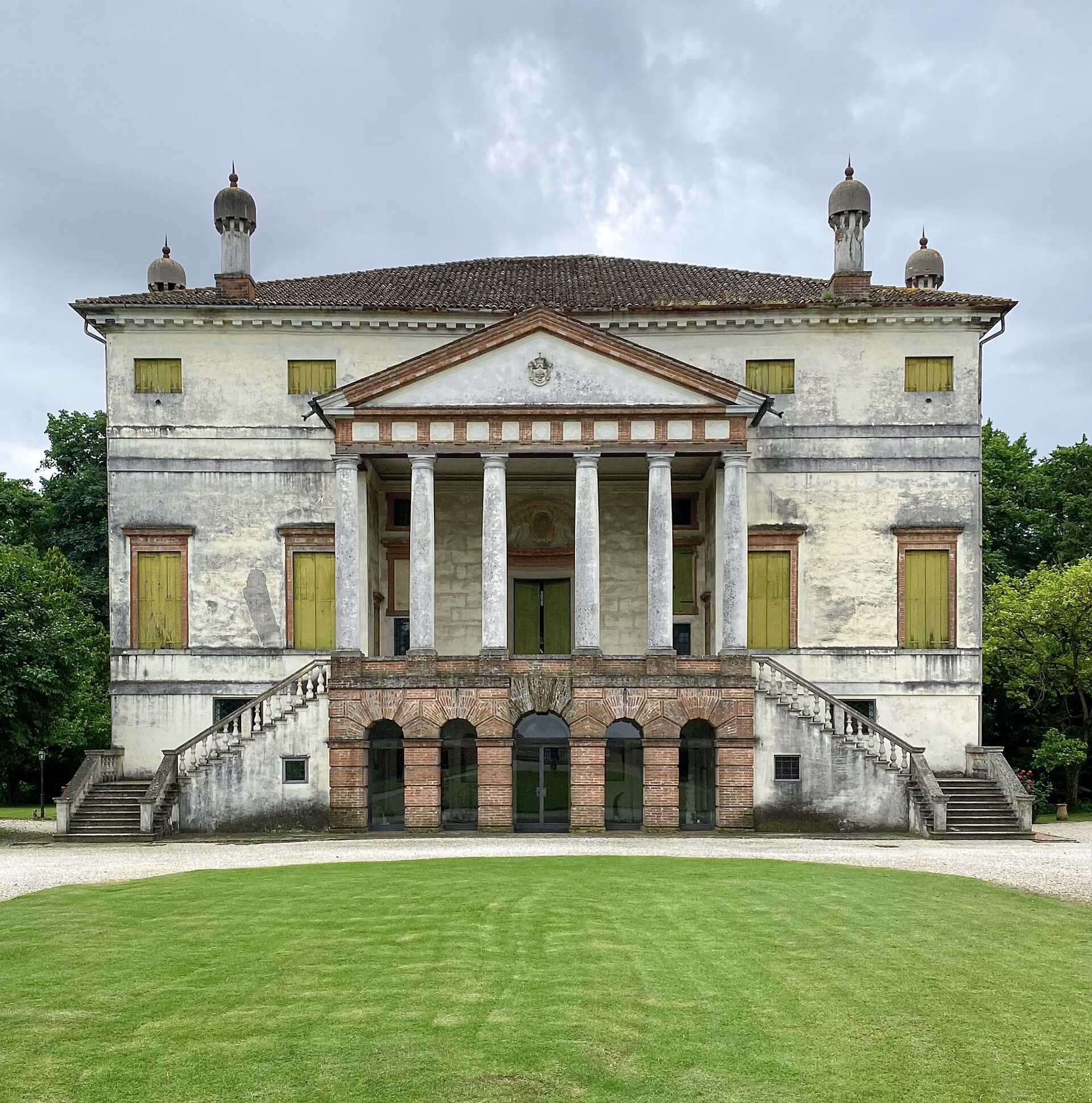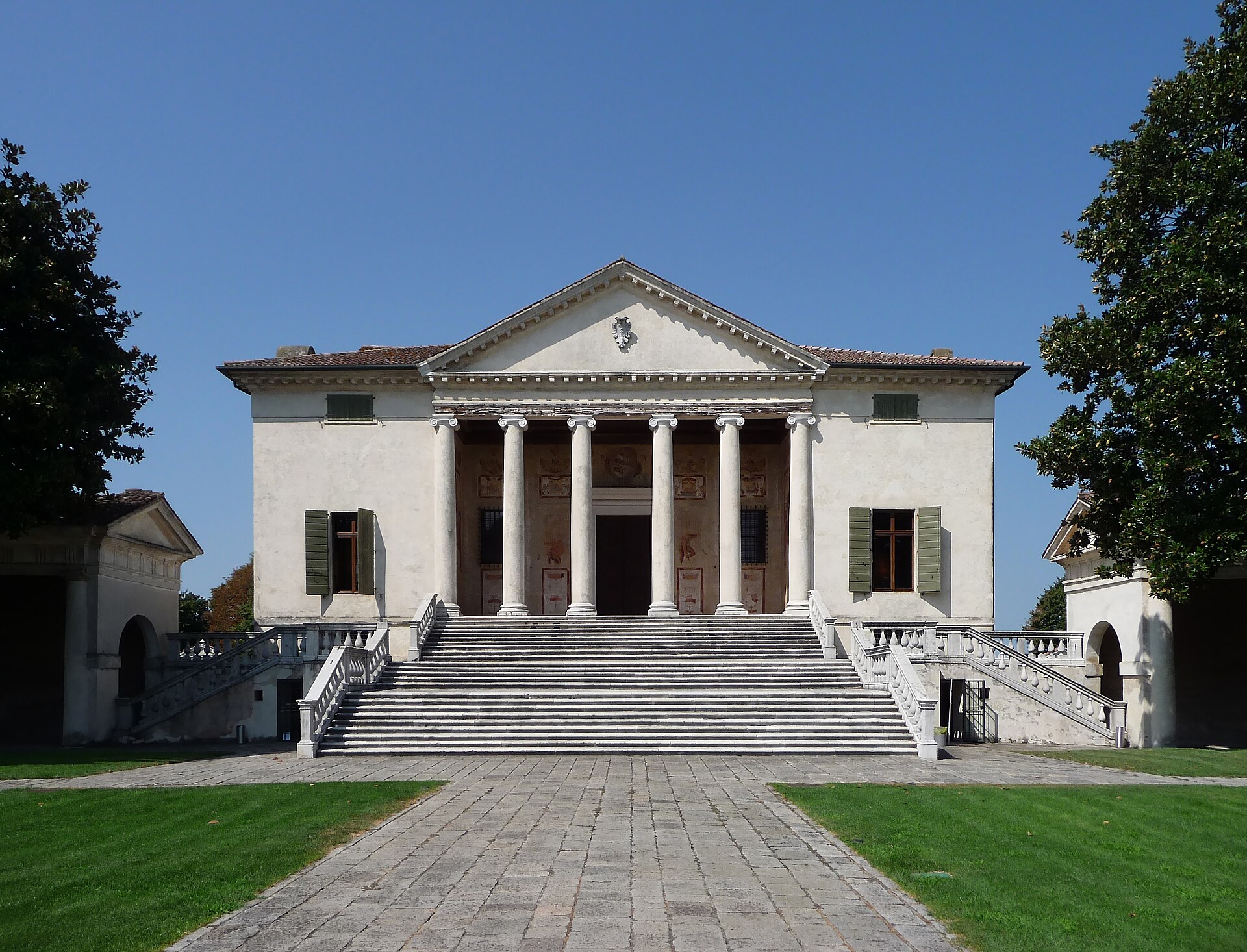
In the countryside of Fratta Polesine stands the only UNESCO site in the province of Rovigo. Villa Badoer was commissioned in 1554 by the Venetian nobleman Francesco Badoer, husband of Lucietta Loredan. Andrea Palladio designed it in 1554–1555, and building work ran from roughly 1556 to 1563.
Here Palladio took a decisive step. For the first time in a villa he made full use of a pedimented portico on the façade: the “temple front” that would become his signature.
A temple above the floods
The villa rests on a high base. It protects the house from river floods and makes it visible from far off across the flat plain. On either side open the curving barchesse, the farm wings of a Venetian villa, reaching out like two arms towards whoever arrives.
They are inspired by the exedrae of the Forum of Augustus in Rome. Of all Palladio’s designs, they are the only curved barchesse he actually built.
The architect published the villa in his Four Books of Architecture in 1570. There he recalled the rooms decorated with “grottesche di bellissima inventione dal Giallo Fiorentino”, grotesques of most beautiful invention by Giallo Fiorentino. The frescoes also celebrate the bond between Francesco Badoer and his brother-in-law Giorgio Loredan. Recent studies identify “Giallo” as the Florentine painter Pier Francesco di Jacopo Foschi, but the attribution remains a hypothesis.
From the Renaissance to the Bronze Age
After passing through several owners, the villa came to the Provincia di Rovigo. Since 1996 it has been part of the UNESCO site “City of Vicenza and the Palladian Villas of the Veneto”.
Since 2009 the north barchessa has housed the Museo Archeologico Nazionale di Fratta Polesine, devoted to Frattesina. Between the 13th and 10th centuries BC this Bronze Age village was a centre of production and trade on a European scale. Glass, bronze and bone were worked here.
So, under one roof, two worlds far apart live side by side. On one hand, the elegance of the Venetian Renaissance. On the other, the hands of the craftsmen who, many centuries earlier, made this plain a crossroads of Europe.