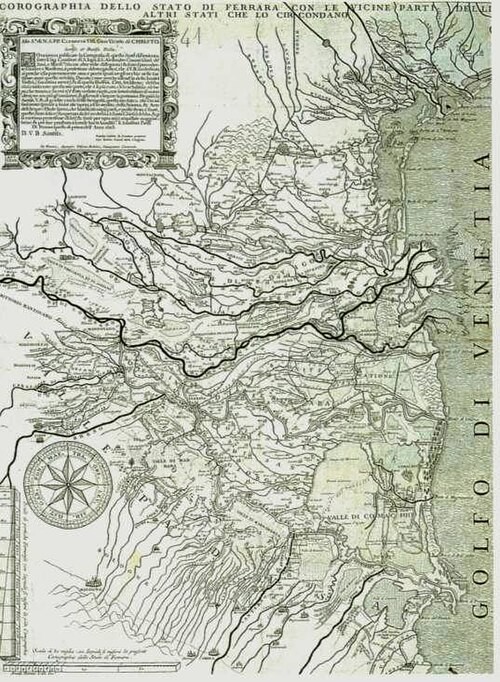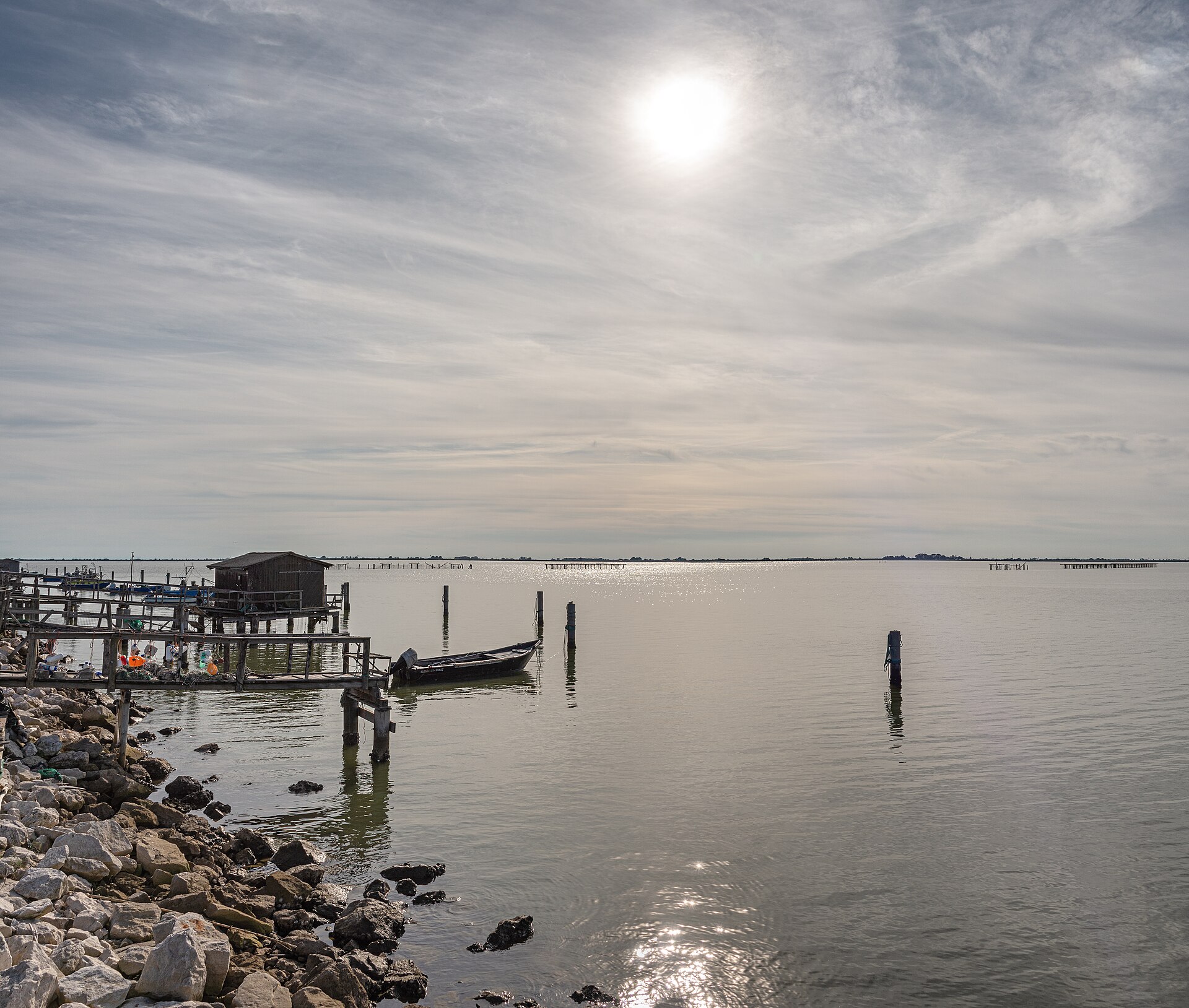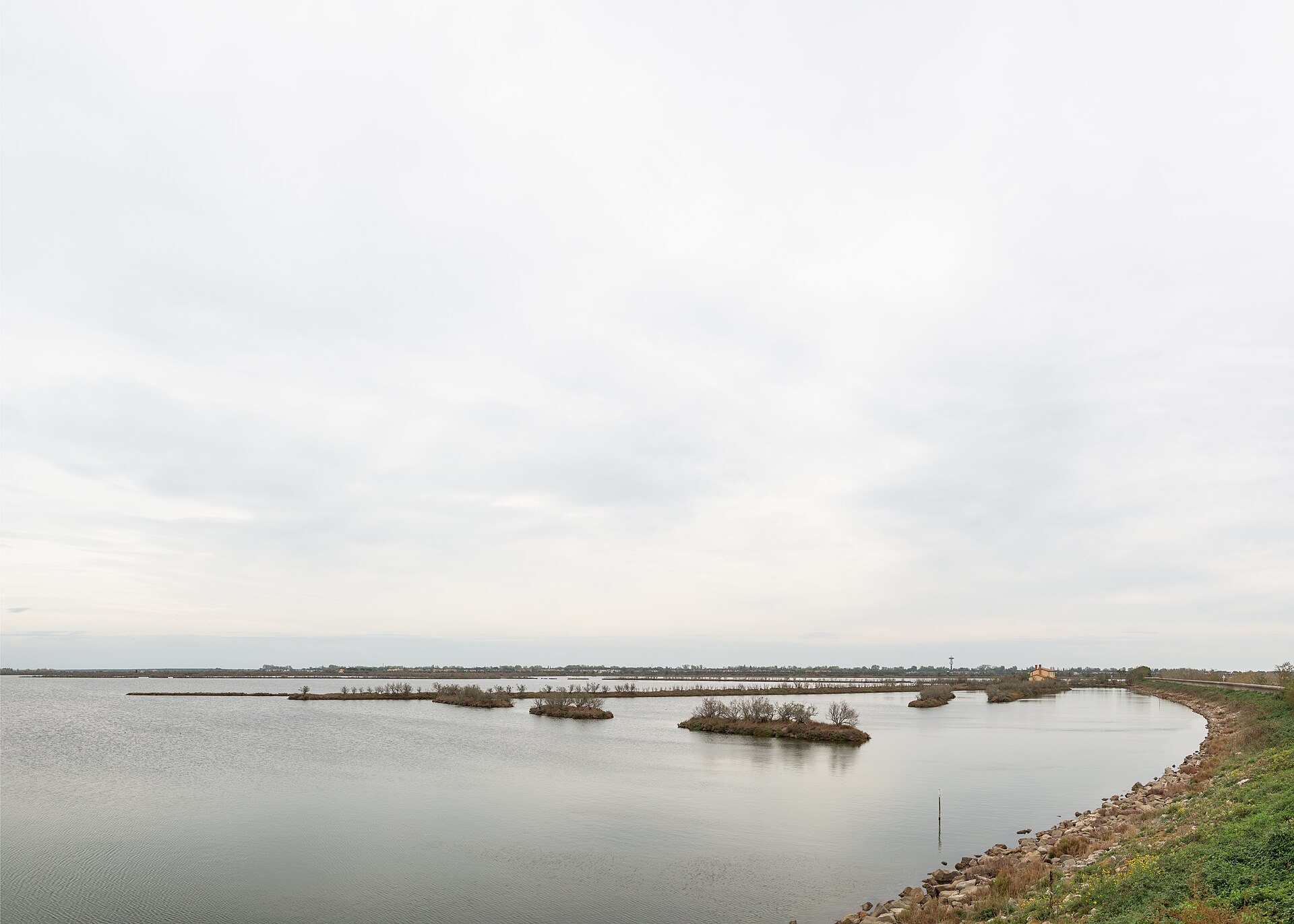
Between the Adige and the Po di Maistra the landscape changes. The land thins into embankments, the water opens into great brackish sheets, reed beds mark the boundaries. These are the valli da pesca, the fishing valli: not natural lakes, but basins built and managed by people to raise fish, at the point where river meets lagoon.
The name itself tells the story. «Valle» comes from the Latin vallum, the embankment: the one raised to close off a stretch of lagoon and turn it into a fish pond, like the piscinae piscariae of the Romans. Over the centuries fishermen refined a precise system. Masonry sluices regulate the flow of water in and out according to the season and the level of the river. The lavoriero, a wooden barrier shaped like an arrow with its point towards the sea, uses the movement of the water to concentrate the fish and catch them. Gilthead bream, grey mullet and sea bass are the time-honoured species.
At the centre of this world was the casone, the home of the valle fisherman. Originally it had a load-bearing wooden frame, with walls and roof of straw and marsh plants mixed with mud; masonry versions appeared around the 17th century. Its heart was a large central hearth, topped by a cube-shaped chimney: it was used for warmth, but above all for smoking eels, the family's reserve of protein.
For generations those who lived in the valli knew the seasonal movements of fish between sea and river like a calendar. That knowledge has not disappeared: today clams and mussels are also farmed in the valli and lagoons of the Delta, and reach the Chioggia fish market and the restaurants of the area.
To see the casoni, the route to take is the Via delle Valli, divided into two sections: in the north near Rosolina, overlooking the Valle Capitania, and in the south near Ca' Pisani, in Porto Viro. It can be walked or, better, cycled along the embankments, among herons, ducks and flamingos. Along the way, osterie and fish-farm restaurants still serve fish from the valli.