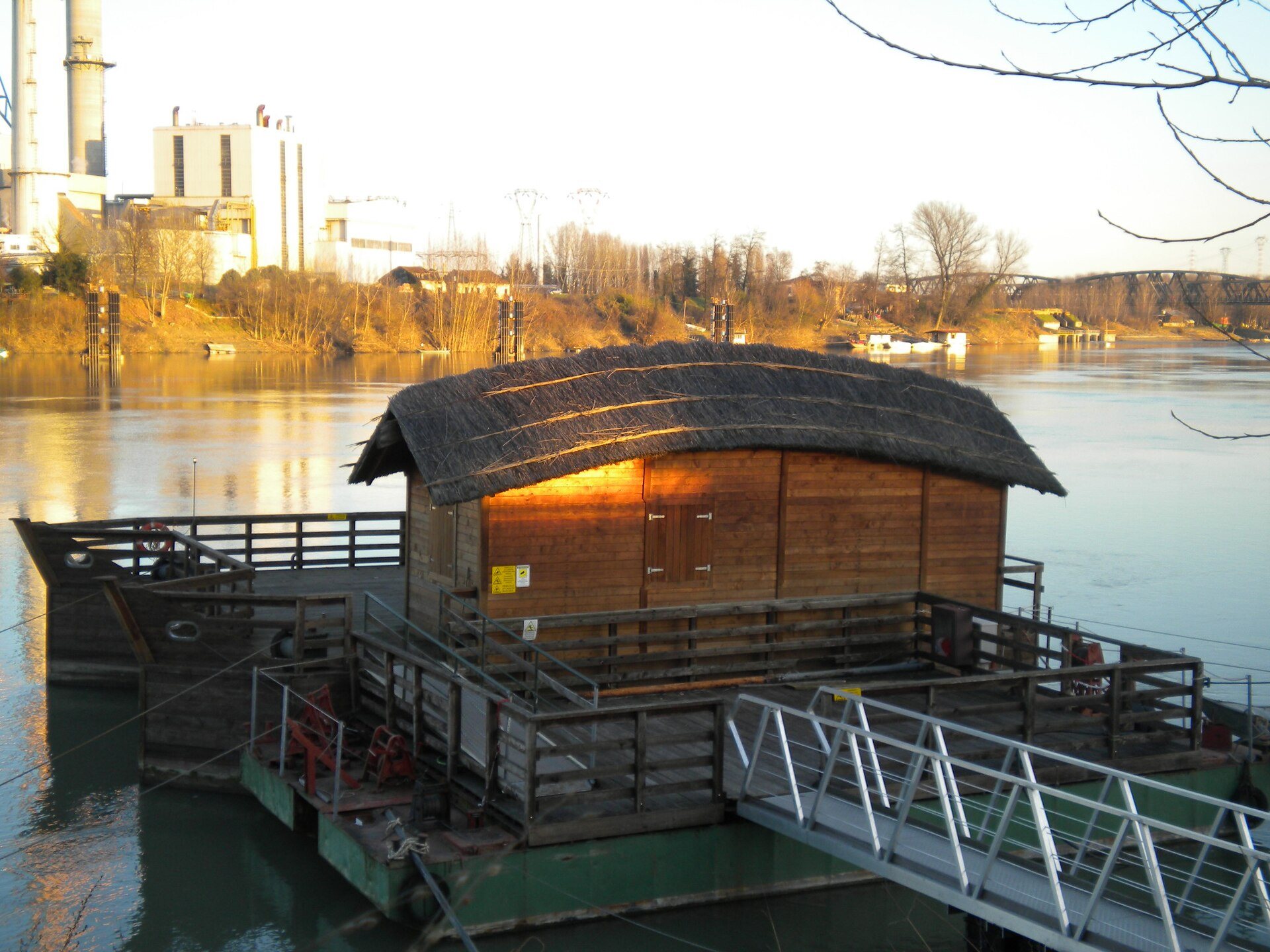
Picture two boats side by side, joined by beams. Between them, a great paddle wheel turned by the current. Above, a small wooden house where millstones turn wheat and maize into flour. For centuries the Po and the Adige were dotted with these structures: the mulini natanti, or floating mills.
They were an ingenious answer to a lowland problem. Where water flows slowly and there are no drops to turn a traditional mill, you take the mill into the middle of the current. Studies on the Veneto describe them like this: two parallel hulls, the wheel between them, the machinery protected in a covered structure, the «arca», and a gangway, the «sandon», for boarding. They were moored to the bank and moved when floods and currents changed; the Paduan and Venetian authorities required an identifying mark on them.
On the Po and the Adige they are recorded from the Middle Ages, and on the Po alone more than three hundred are documented, from Cremona to the mouth. As late as 1902 the Commission for Inland Navigation counted 266 along the Po: 91 were in the Rovigo area, almost as many as around Mantua. In the 19th and early 20th centuries they were at the centre of the river's economic and social life.
Then the world changed. Steam navigation and tugs made them an obstacle, concessions were not renewed, electricity moved mills onto dry land. They began to disappear at the start of the 20th century; the last one on the Po, according to the accounts, was destroyed by an air raid on 2 January 1945. The writer Riccardo Bacchelli preserved their memory in the novel «Il mulino del Po» (The Mill on the Po).
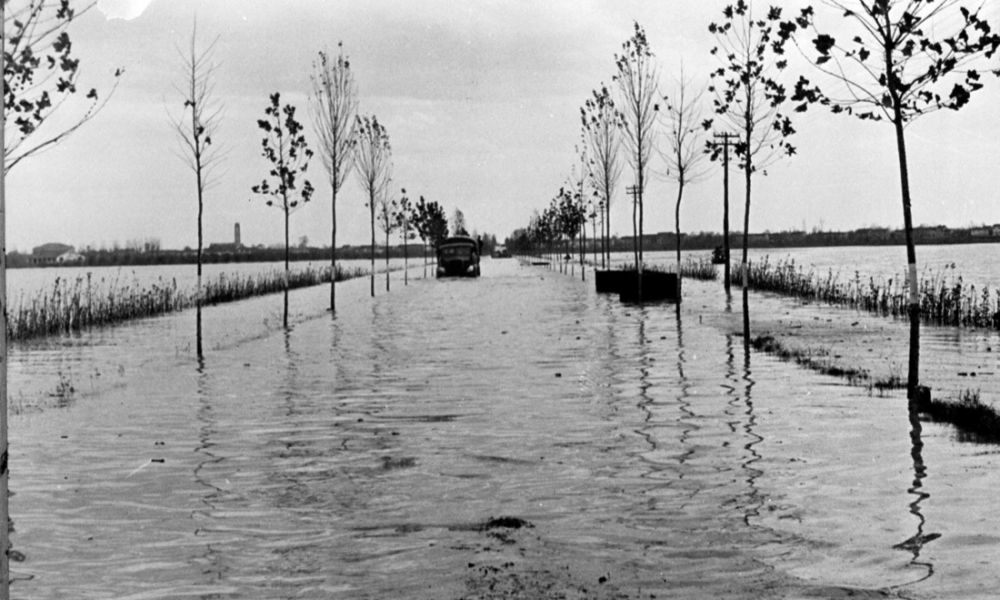
In the Polesine the place to find them again is the Museo delle Acque in Crespino, opened in 2004 in piazza Fetonte. Alongside the tools of the flood wardens, a traditional fishing boat and mementoes of the 1951 flood, it holds a faithful reconstruction of the last floating mill of the Passetto locality. Anyone wanting to see a mill rebuilt on the river can go just over the border to Revere, in the Mantua area, where FAI points to the one linked to the Museo del Po.