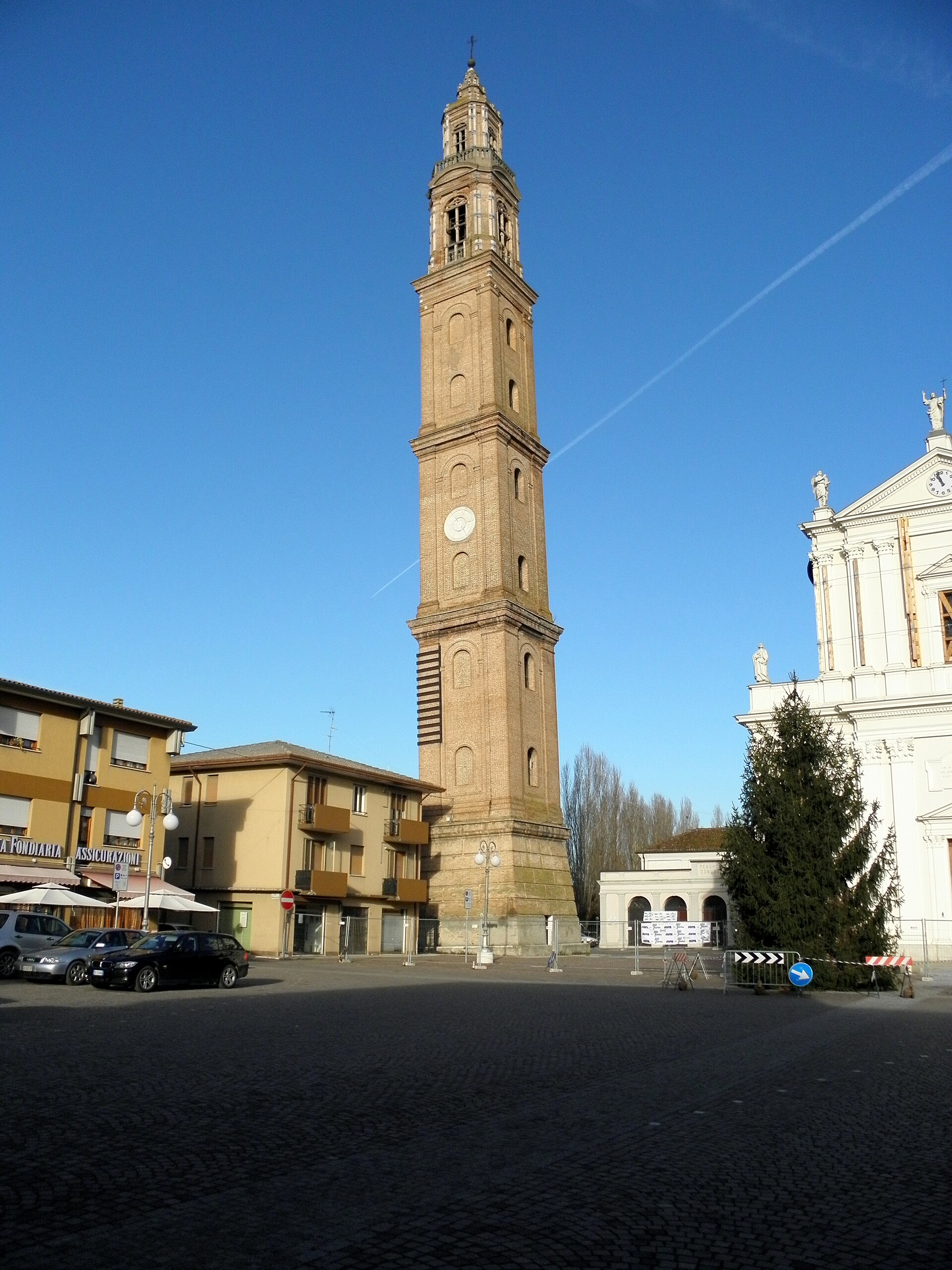
Arrive in Ficarolo along the Po embankment and you immediately see a tower that seems to bend. Yet the bell tower of the Church of Sant’Antonino Martire does not simply lean. Its profile is ‘broken’ into three sections, the proof of a long struggle between its builders and a yielding soil.
A troubled construction
A study by the IUAV University of Venice on the consolidation and restoration of the tower reconstructs its history. The foundations were laid in 1777, after the parish church had been completed.
The design was by the Ferrara architect Gaetano Barbieri (1711–1797), while construction was entrusted to the master builder Giuseppe Occari. Work stopped several times, for structural and financial reasons, and was finished in September 1790.
The ground that gives way
The chosen spot was close to the ‘fossa mantovana’, an open drainage channel, and the ground was very weak. When the tower had reached about a third of its height, the structure began to sink.
The masons did not give up. Again and again they corrected the alignment of the walls to compensate for the tilt. From the square you only need to look up to notice it: the tower seems to change its mind as it rises. The result is its distinctive three-part profile, which still tells of that challenge, brick by brick.
Including the cross, the tower rises above 75 metres. The list of Italy’s tallest bell towers records it at 71.70 metres, probably using a different method of measurement.
Wounded and cared for
The Emilia earthquakes of 20 and 29 May 2012 damaged the base of the belfry and brought down some of the arches supporting the spire.
The 2014 restoration strengthened the tower with reinforced stainless-steel stitching, injections of lime mortar, steel-cable ties and carbon-fibre bars. Today’s techniques in the service of a stubbornness more than two centuries old. And so the crooked tower keeps watch over the village and the river.