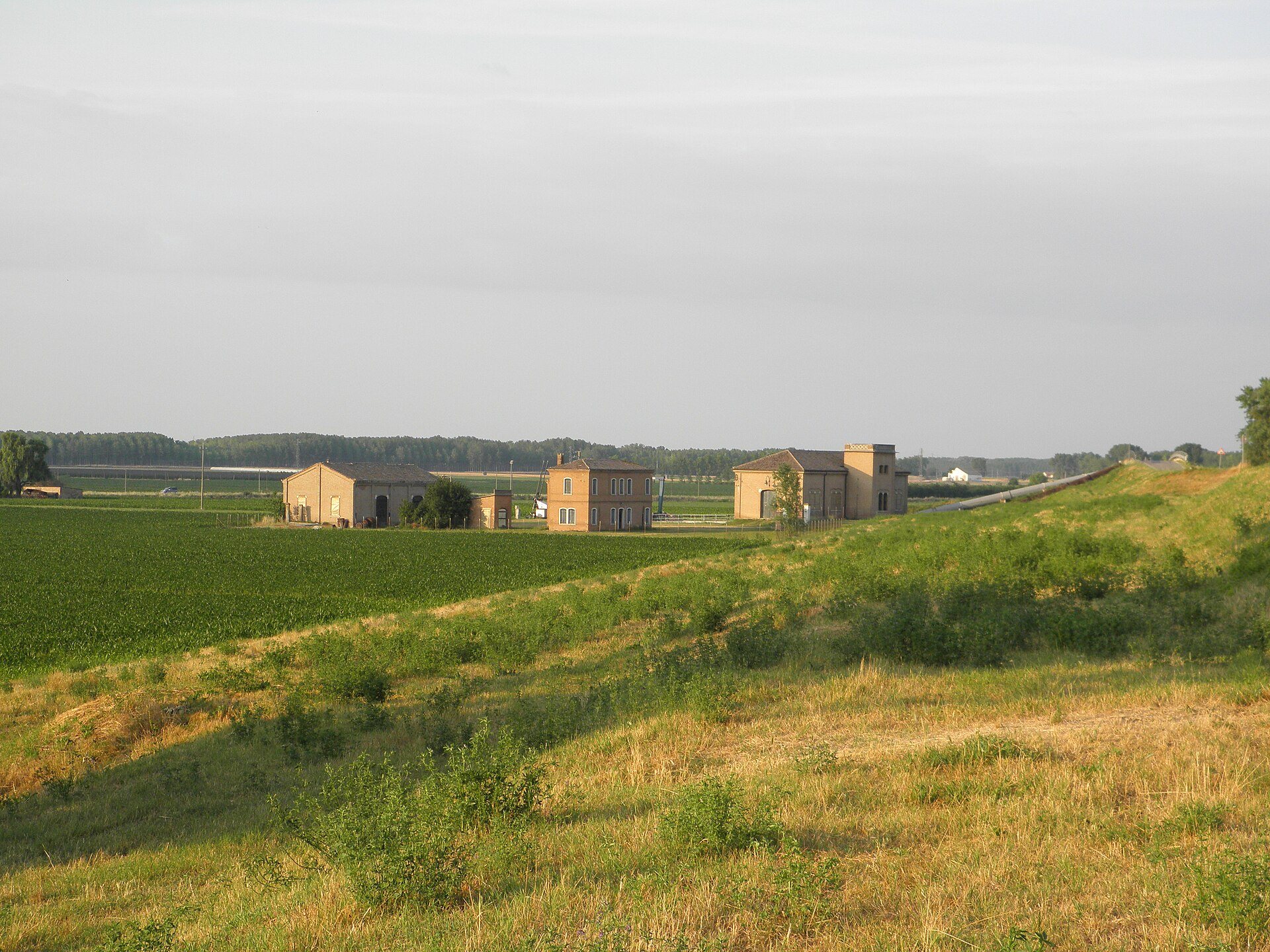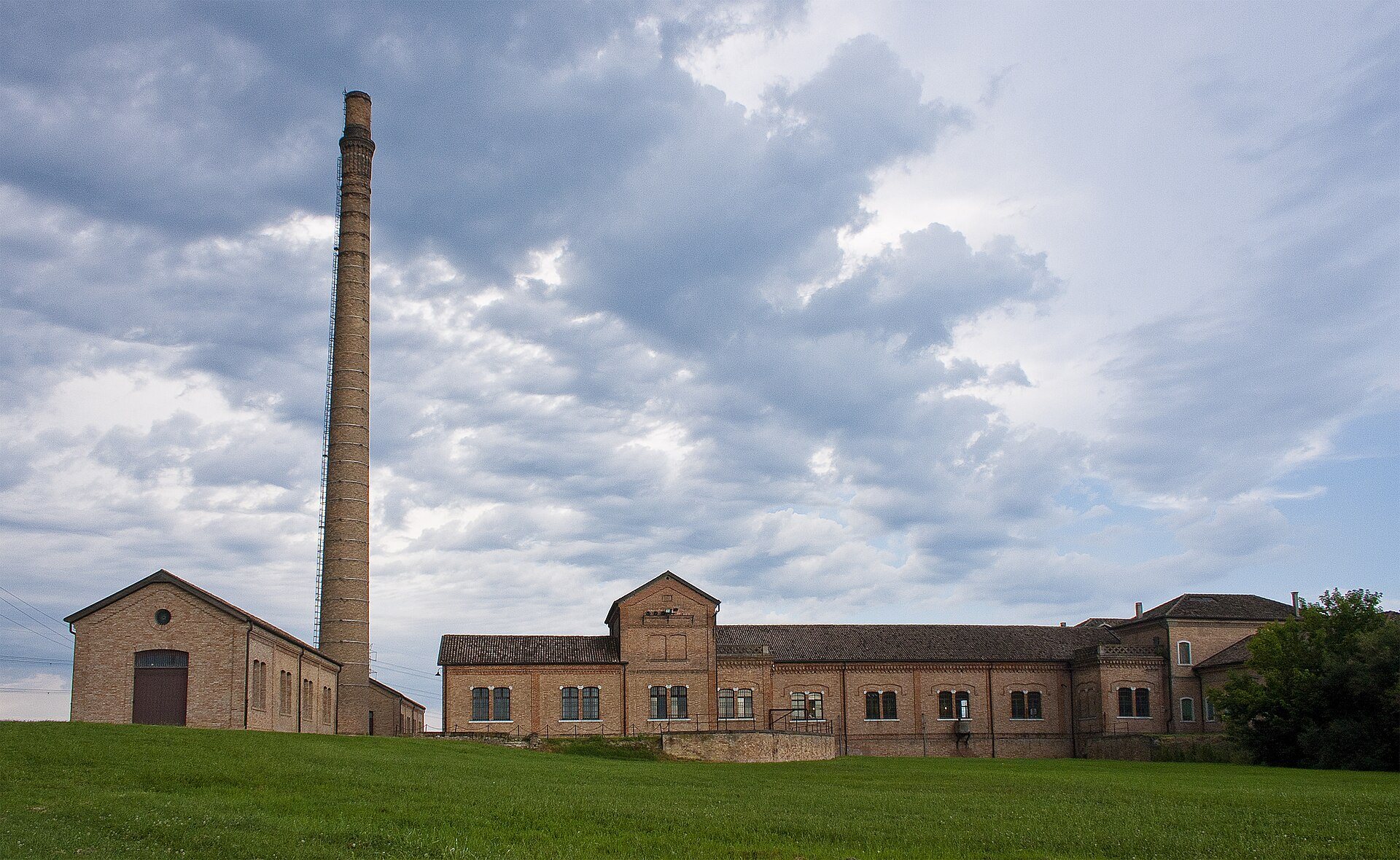
In the Po Delta the land was not found: it was made. You understand this standing in front of the former pumping station of Ca' Vendramin, a frazione of Taglio di Po. A large brick building, a chimney sixty metres high, and around it flat fields stretching to the horizon. A century ago, many of those fields were water.
The Isola di Ariano had been managed by drainage consortia since the 18th century, but natural drainage was not enough. From 1883 the municipalities of Ariano, Corbola and Taglio di Po had been calling for mechanical drainage. The Genio Civile of Rovigo drew up a first project in 1886, the engineer Domenico Donzelli a general plan in 1895, reworked by the consortium's engineer Antonio Zecchettini. In 1900 the decree arrived, and on 13 September work began.
The plant was commissioned in 1905. Inside were four centrifugal pumps driven by steam engines, fed by ten coal-fired boilers; the fumes ran through an underground flue to the chimney. They could lift about 11,000 litres of water per second. The bricks came from the Camisotti kiln in Santa Maria in Punta, and the mechanical parts were assembled by the Cordella workshop in Adria. A generator also produced electricity for two smaller pumping stations, Argana and Cappellona.
In 1921, with coal too expensive after the war, part of the plant was switched to electricity. In 1925 Ca' Vendramin was presented at the Naples Exhibition. Then the enemy came from below: subsidence. In December 1954 engineers measured that the building had sunk 40 centimetres in five years; the floods of 1957 and 1960 upset the water regime. In 1969 the pumping station stopped.
Today it is the Museo regionale della bonifica (Regional Museum of Land Reclamation), run by the Fondazione Ca' Vendramin. Visitors can see the steam boilers, the centrifugal pumps, the old workshop and the historical archive of the Delta's land-reclamation bodies; the former boiler room has become a conference hall named after its designer. It is the right place to understand what it means to live below the level of the water.