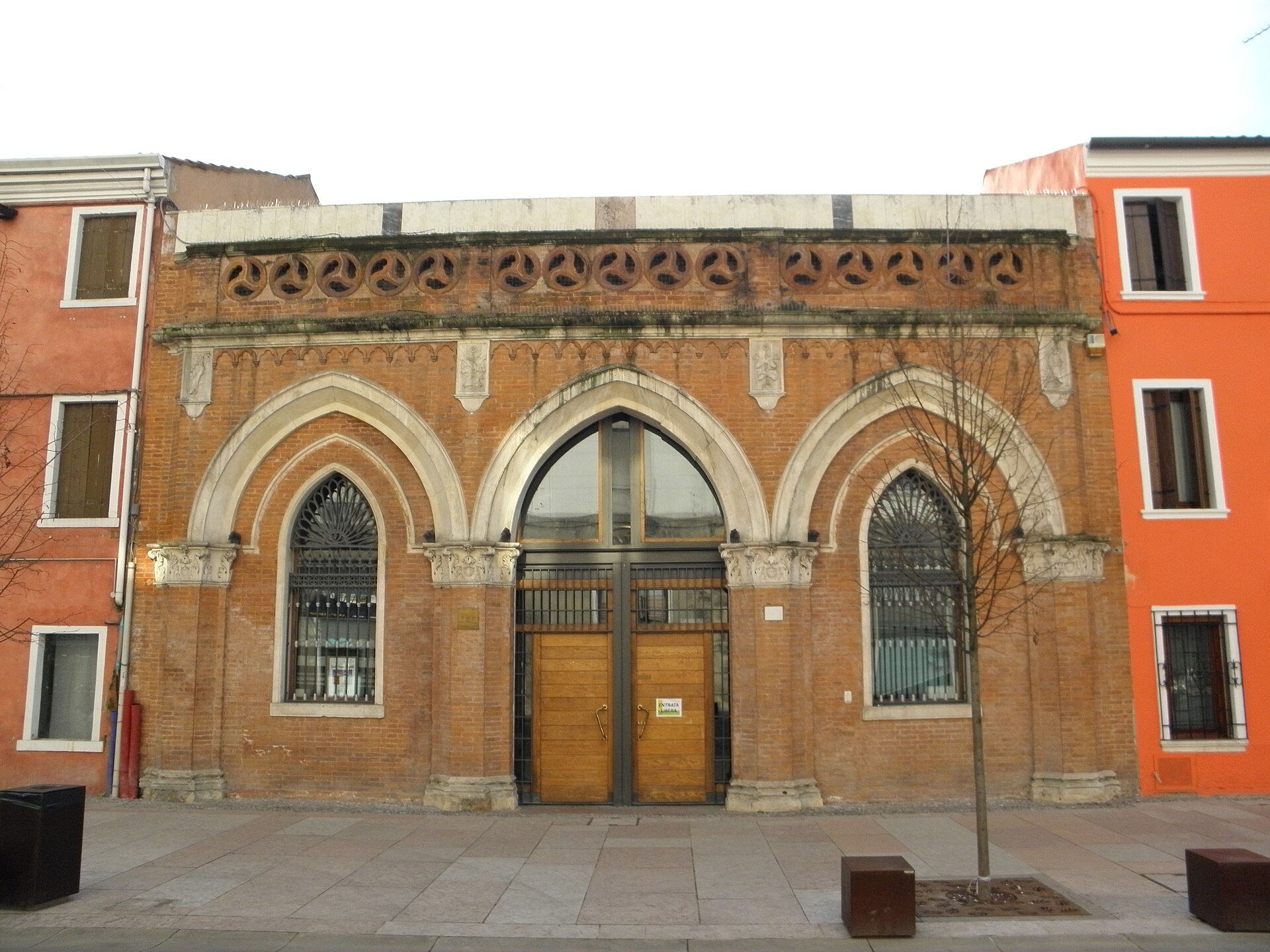
Among Rovigo’s civic buildings, the Pescheria Nuova (the “New Fish Market”) is perhaps the most surprising. It is a fish market dressed up as a little Gothic palazzo. It was built around 1870, in the years when the city was being renewed. It was to replace an 18th-century fish market and improve hygiene in the sale of fish, a pressing concern in the 19th century. Hygiene and modernity were the watchwords of the age. But the real surprise lies in the way the building is made.
Gothic outside, Paris within
The façade looks to the Middle Ages. A great doorway opens at the centre, flanked by two pointed-arch windows. Along the top runs a balustrade that the Regione Veneto describes as Art Nouveau. Seen from the street, the building could pass for a small church or a nobleman’s house. It is the first deception, and the most charming.
Step inside and the scene changes completely. The contrast between outside and in is this building’s secret. The interior is a manifesto of wholly industrial modernity, cutting-edge for its time. The bright, spacious hall rests on cast-iron columns and pairs iron with glass, materials “much in vogue in the Paris of the day”. The fresh catch was laid out on white marble counters. For the Regione Veneto, the building is “an important example of industrial and engineering architecture” of the late 19th century: a meeting, in a few square metres, between a taste for the past and faith in technology.
From market to a hall for the city
For about a century the Pescheria served as a fish market, until the late 20th century. After a restoration at the end of the century it became a multi-purpose hall. Today it hosts temporary exhibitions, conferences and cultural events. Where people once haggled over fish, they now look at art and listen to talks, beneath the same cast-iron columns. Its story is that of many civic buildings: born for one purpose, saved by another. It is worth going in when it is open, to see the hall for yourself.